Cool thread!
Oh Oh, pick me! Sorry, this may not interest everyone, but I thought it was mucho neato.

This has been covered in many books lately, but I've never seen it laid out so well.
So this past weekend I attended (yet another) conference on food policy. There was an excellent speaker, an economist who demonstrated the following connection:
In 1973 or so the Sec. of Agriculture (U.S.) was named Earl Butz. He pushed for a vast increase in commodity farming, urging American farmers to plant "fencerow to fencerow". He hoped to increase supply and in doing so increase demand by opening up new export markets overseas. I will spare the kittens my opinion of this economic stategy....
So this worked for a couple years as wheat, etc. was shipped overseas to Russia in particular. Then, as overseas agriculture recovered, that market crashed, leaving farmers with incredible debt (they had expanded to meet the promised "long-term" market), vast commodity grain surpluses and no place to sell their product at a profit (if at all).
This was one of the main causes of the farm crises in the 80's, and the move away from small scale family farms. It also, it turns out, likely has a lot to do with childhood obesity problems today.
Turns out that about that time, someone thought that all that extra corn could be processed into high fructose corn syrup. So it was marketed rather extensively (because what the hell else were they going to do with all that corn). So as commodity farms failed, high fructose corn syrup use increased because it was marketed as a cheap alternative to sugar.
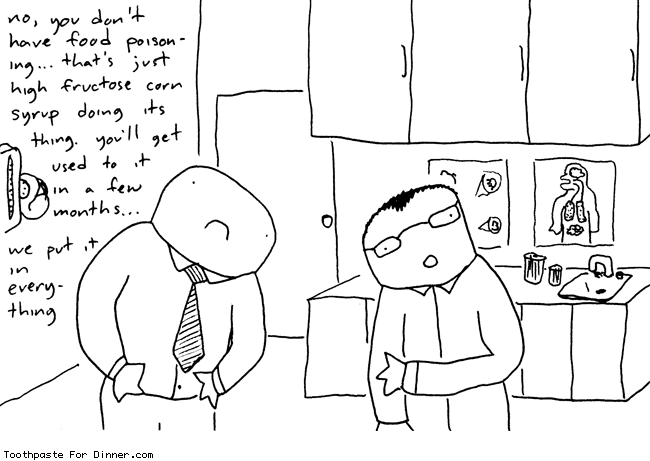
As most folks who look at labels can attest, high fructose corn syrup is an additive in almost all processed foods today.
Now! To my point! If you look at a graph that shows that increase in the use of high fructose corn syrup, and then you overlay a graph showing the increase in childhood obesity in the U.S., those curves show remarkable correlation. Almost as soon as high fructose corn syrup increased, so did childhood obesity.
So the decision to increase commodity grain production for export had a direct (if entirely unpredictable) effect on the obesity of U.S. citizens by way of creating a back door market for surplus corn in the form of high fructose corn syrup.
Sort of horribly neat, isn't it?
Sorry, I'm turning into a farming geek...
Don't confuse me with your reasonableness.


 }
}

 The use of corn syrup as a sweetner is something that really pisses me off, and so I love to learn more about it so I can sound even more high-falutin when I rant about it at cocktail parties and on long road trips. (It is necessary to insert a note here that my girlfriend is a wonderful, patient woman.)
 I'll try and be more upbeat with my "what I learned today" in the future!